


 Image
Travel posters
Little Worlds — 3D Miniature Travel Poster
Little Worlds transforms destinations into intricate miniature travel scenes that appear to float above a warm, textured paper background. Inspired by handcrafted architectural models, sculptural dioramas, and premium travel illustration, each composition captures a place through its most distinctive landscapes, landmarks, flora, wildlife, architecture, and cultural details. Complete with dimensional typography, editorial headlines, descriptive subheadings, location stamps, miniature signboards, and illustrated feature labels, every artwork becomes a collectible visual story of a place.
Create a premium, intricately detailed 3D miniature travel-poster diorama celebrating {{DESTINATION}}, located in {{REGION_OR_COUNTRY}}.
The artwork should look like a carefully handcrafted miniature world, built as a sculptural landscape model and photographed against a warm, lightly textured paper background. Combine realistic miniature craftsmanship, delicate materials, layered terrain, tiny environmental details, elegant editorial typography, and sophisticated travel-poster composition.
1. Destination Research and Creative Direction
Identify what makes this destination visually and culturally distinctive. Select a strong central concept based on its actual geography, architecture, ecology, heritage, local lifestyle, or recognizable landmarks.
Destination: {{DESTINATION}}
Region or Country: {{REGION_OR_COUNTRY}}
Signature Identity: {{SIGNATURE_IDENTITY}}
Main Landmark or Subject: {{MAIN_LANDMARK}}
Distinctive Landscape: {{LANDSCAPE_DETAILS}}
Architecture and Heritage: {{ARCHITECTURE_AND_HERITAGE}}
Flora and Wildlife: {{FLORA_AND_WILDLIFE}}
Culture and Local Life: {{CULTURE_AND_LOCAL_LIFE}}
Main Creative Concept: {{CREATIVE_CONCEPT}}
Color Palette: {{COLOR_PALETTE}}
Main Heading: {{MAIN_HEADING}}
Subheading: {{SUBHEADING}}
Primary Tagline: {{PRIMARY_TAGLINE}}
Feature Stamp Text: {{FEATURE_STAMP}}
Location Signboard Text: {{LOCATION_SIGNBOARD}}
Footer Feature Labels: {{FOOTER_LABELS}}
When a variable is empty, intelligently select suitable details based on the destination. Keep the artwork grounded in real local identity and avoid inventing landmarks, traditions, or attractions.
2. Build a Floating Miniature World
Create one cohesive, three-dimensional miniature landscape floating above a clean, warm ivory or cream paper background.
Construct the landscape as a sculptural island with a clearly visible side profile. Use layered geological strata, miniature rock formations, textured soil, tiny vegetation, architectural elements, winding paths, water features, or other details appropriate to the destination.
The terrain should have a convincing physical structure, with carefully sculpted edges and subtle shadows beneath it, making the entire scene appear suspended in space.
Adapt the shape of the floating landscape to the destination. It could resemble a rocky plateau, an urban island, a terraced garden, a historic town, a forest clearing, a river settlement, or another distinctive environment.
Do not force every destination into the same landscape shape.
3. Miniature Detail and Material Realism
Populate the miniature world with intricate, small-scale details that reward closer inspection.
Depending on the location, incorporate miniature buildings, distinctive rooftops, pathways, tiny visitors, bridges, plants, flowers, trees, streams, boats, wildlife, observation points, or regional objects.
Use tactile materials such as sculpted clay, textured paper, carved wood, natural stone, moss, delicate foliage, and realistic miniature water.
Every element must share a consistent scale and believable physical construction. Add subtle surface imperfections, fine textures, delicate shadows, and natural variation to create the feeling of a handcrafted collectible model.
Keep the composition rich but not cluttered. One strong central subject should lead the eye, with smaller details supporting the destination story.
4. Destination-Specific Storytelling
Make the scene unmistakably recognizable as {{DESTINATION}}.
Choose the location's strongest visual identifiers rather than relying on generic tourism imagery.
For a flower-filled plateau, emphasize seasonal wildflowers, basalt rock, botanical diversity, miniature trails, and a natural lookout. For a historic city, create a compact architectural skyline with characteristic streets and landmarks. For a forest destination, use dense miniature vegetation, wildlife, streams, and small shelters. For a coastal town, use characteristic buildings, harbors, and maritime details where appropriate.
Avoid automatically adding mountains, beaches, waterfalls, temples, monuments, or other familiar scenery unless they are genuinely relevant.
Preserve geographic and cultural authenticity while using a slightly whimsical miniature scale.
5. Editorial Typography System
Design the typography as an integral part of the poster, not as an afterthought.
Main heading: Display {{MAIN_HEADING}} beneath or above the miniature scene in elegant, prominent typography. Use refined handwritten lettering, sculptural serif lettering, or another type style suited to the destination.
Subheading: Include {{SUBHEADING}} as a clear supporting title that explains the destination or its defining identity.
Primary tagline: Place {{PRIMARY_TAGLINE}} in a smaller editorial line to add character and emotion.
Feature stamp: Add a circular, postage-inspired stamp containing {{FEATURE_STAMP}}. Keep it compact and visually balanced.
Location signboard: Integrate a miniature physical sign containing {{LOCATION_SIGNBOARD}} into the landscape when appropriate.
Footer feature labels: Add a neatly spaced row of three or four small feature labels using {{FOOTER_LABELS}}, paired with simple, location-relevant icons.
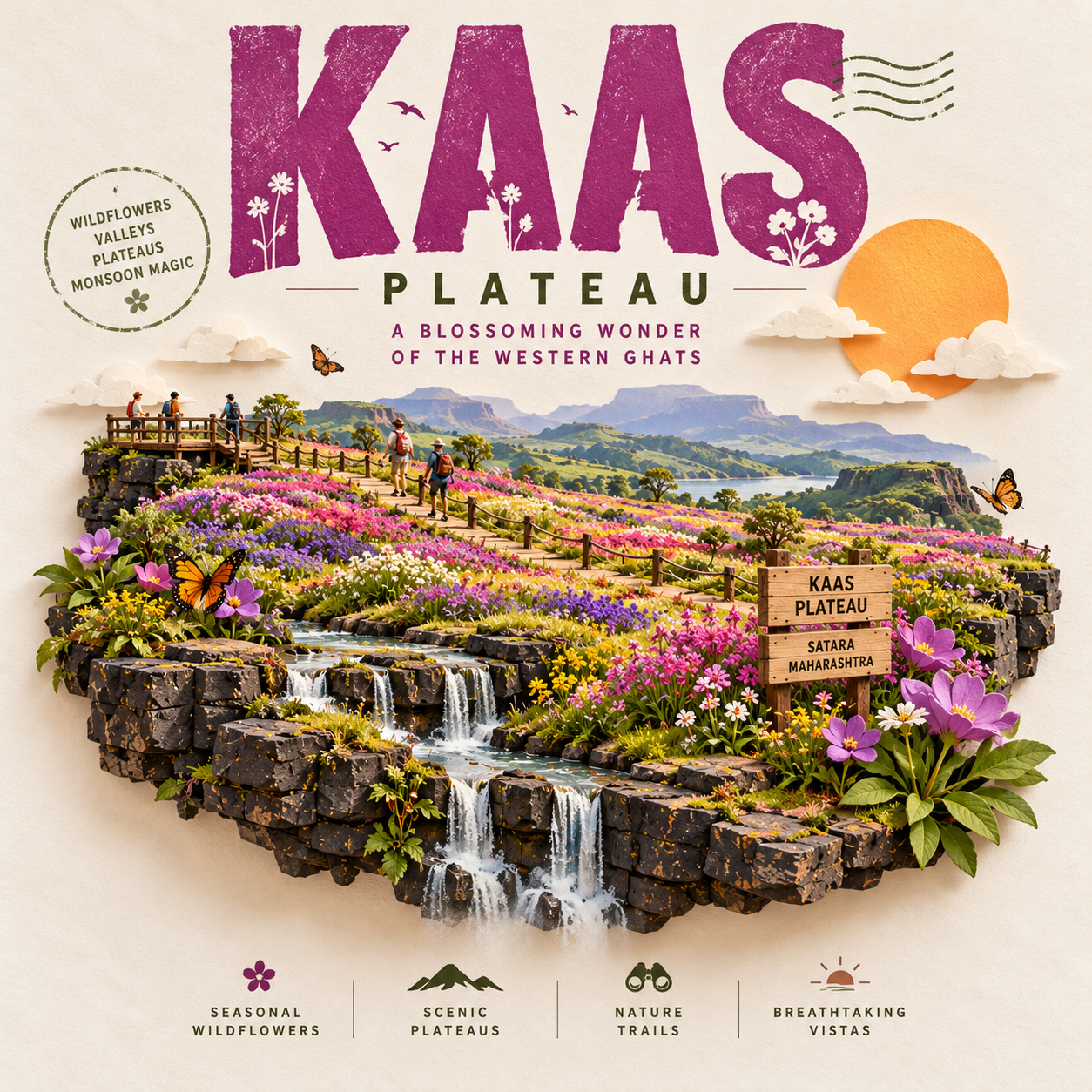
For example, a Kaas Plateau design might feature:
Main heading: KAAS
Subheading: PLATEAU
Primary tagline: A BLOSSOMING WONDER OF THE WESTERN GHATS
Feature stamp: WILDFLOWERS · VALLEYS · PLATEAUS · MONSOON MAGIC
Location signboard: KAAS PLATEAU · SATARA
Footer labels: SEASONAL WILDFLOWERS · SCENIC PLATEAUS · NATURE TRAILS · BREATHTAKING VISTAS
Treat these as examples, not fixed text. Automatically adapt the wording to each destination.
Ensure the text is correctly spelled, readable, properly aligned, and organized into a clear hierarchy. Avoid random letters, duplicated words, excessive captions, and unsupported factual claims.
6. Background and Atmospheric Details
Use a softly textured warm-cream background with generous negative space around the floating scene.
Add a small number of complementary decorative elements above or around the landscape, such as sculpted clouds, a simple sun, tiny birds, butterflies, miniature paper elements, or subtle botanical illustrations.
Select these details according to the destination and composition. They should enhance the sense of scale and atmosphere without distracting from the main diorama.
Create realistic soft studio lighting, gentle ambient occlusion, and delicate cast shadows beneath the landscape and decorative objects.
The mood should feel calm, refined, imaginative, and premium.
7. Color and Art Direction
Palette: {{COLOR_PALETTE}}
When no palette is provided, derive a distinctive color scheme from the destination's natural environment and cultural character.
Use harmonious colors for the terrain, vegetation, architecture, decorative elements, and typography. Balance natural, muted tones with a few vivid accents.
Avoid automatically using the same greens, pinks, and cream tones for every destination. Each poster should have its own visual identity while retaining the same handcrafted miniature-diorama aesthetic.
8. Final Composition and Output
Aspect ratio: EXACTLY 1:1 square, 1024 × 1024.
Design the entire composition specifically for a square canvas. Do not crop a portrait poster into a square.
Balance the floating miniature landscape with the heading, subheading, tagline, feature stamp, location signboard, and footer labels. Keep text readable and prevent decorative elements from colliding with the edges.
The scene should be visually substantial, intricately detailed, and clearly separated from the background by realistic shadows.
Final quality: Premium miniature craftsmanship, highly detailed sculptural terrain, realistic material textures, beautiful environmental storytelling, elegant editorial typography, soft studio lighting, dimensional depth, and collectible travel-poster art direction.
Negative constraints: No generic landscape repeated for every destination, no mandatory mountains or beaches, no unrelated landmarks, no inaccurate cultural symbols, no flat-only vector artwork, no oversized people, no inconsistent miniature scale, no cluttered typography, no random text, no watermarks, no unnecessary logos, no white padding, and no aspect ratio other than 1:1.