


 Image
Magazine covers
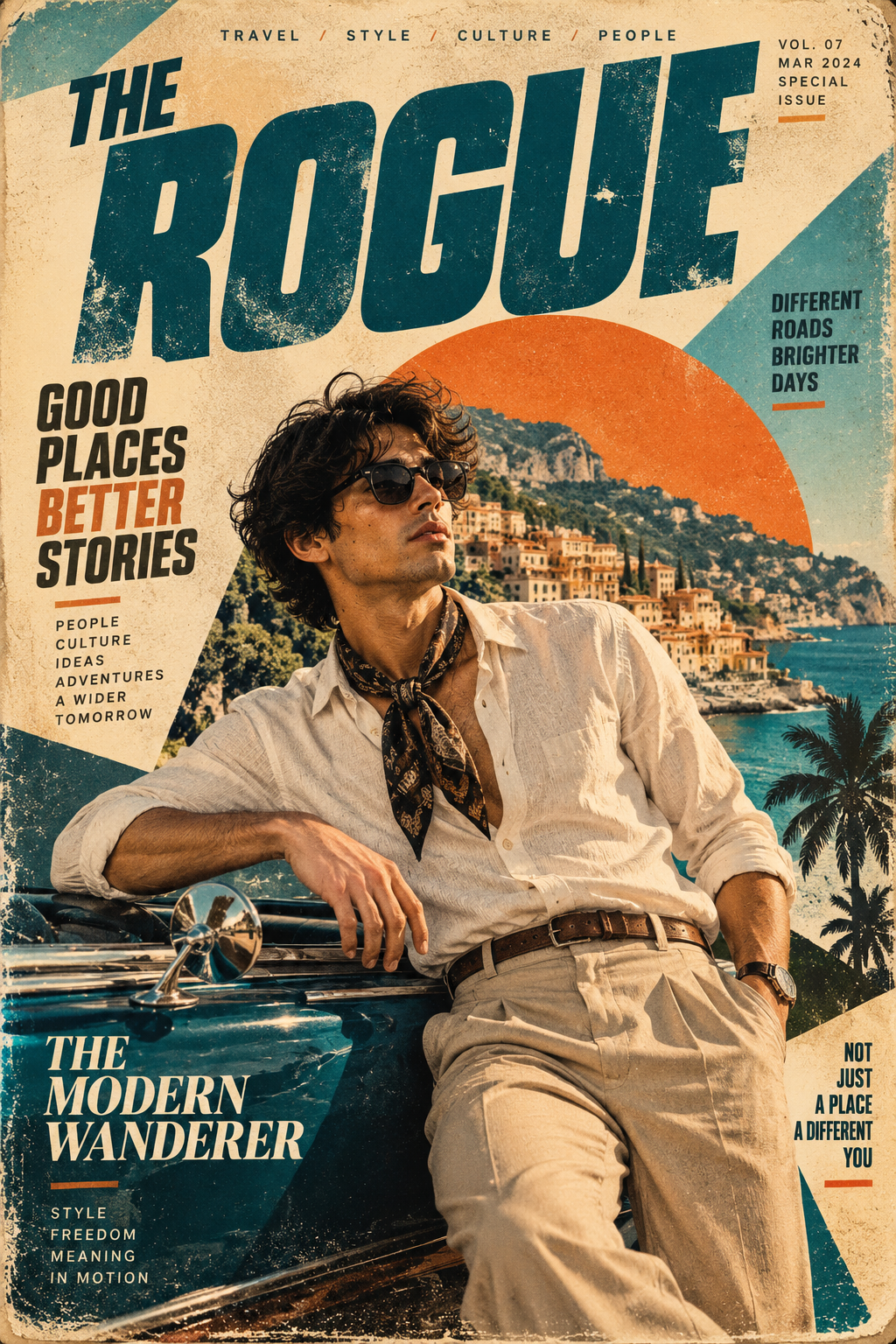
THE ROGUE — Retro Pulp Magazine Cover
THE ROGUE is a retro-inspired editorial magazine cover generator that blends mid-century pulp illustration, vintage travel advertising, classic film photography, and bold publication design. Create distinctive covers featuring male models, expressive fashion styling, iconic locations, vintage vehicles, architectural backdrops, and meaningful editorial headlines. Experiment with different personalities, cultural backgrounds, outfits, environments, and color combinations while retaining the nostalgic character of aged paper, screen printing, halftone textures, and distressed typography.
Create a visually striking, original vintage magazine cover inspired by mid-century pulp publications, classic travel advertisements, retro lifestyle photography, and distressed screen-printed graphic design.
The composition should feature one distinctive adult male model as the main subject, surrounded by bold editorial typography, vintage geometric shapes, atmospheric environmental photography, and meaningful cover stories.
The final artwork should feel like an authentic collectible magazine cover discovered in an old print archive, combining photographic realism with vintage graphic-design treatments.
Every generation must be capable of producing a new model, outfit, location, editorial concept, color palette, and composition.
A. Dynamic Inputs
Magazine Identity
Magazine name: [MAGAZINE_NAME]
Magazine subtitle: [MAGAZINE_SUBTITLE]
Issue number: [ISSUE_NUMBER]
Publication date: [PUBLICATION_DATE]
Special edition: [SPECIAL_EDITION]
Magazine category: [MAGAZINE_CATEGORY]
Publication tagline: [PUBLICATION_TAGLINE]
Male Model
Model name: [MODEL_NAME]
Adult age range: [AGE_RANGE]
Ethnicity or cultural background: [ETHNICITY]
Nationality: [NATIONALITY]
Skin tone: [SKIN_TONE]
Face shape: [FACE_SHAPE]
Facial features: [FACIAL_FEATURES]
Eye color: [EYE_COLOR]
Hairstyle: [HAIRSTYLE]
Facial hair: [FACIAL_HAIR]
Body build: [BODY_BUILD]
Expression: [EXPRESSION]
Pose: [POSE]
Personality: [PERSONALITY]
Fashion and Styling
Fashion aesthetic: [FASHION_AESTHETIC]
Main outfit: [MAIN_OUTFIT]
Outerwear: [OUTERWEAR]
Footwear: [FOOTWEAR]
Accessories: [ACCESSORIES]
Clothing materials: [MATERIALS]
Styling details: [STYLING_DETAILS]
Editorial Concept
Main theme: [EDITORIAL_THEME]
Main headline: [MAIN_HEADLINE]
Supporting headline: [SUPPORTING_HEADLINE]
Secondary coverlines: [SECONDARY_COVERLINES]
Featured story: [FEATURED_STORY]
Short description: [STORY_DESCRIPTION]
Featured quote: [FEATURED_QUOTE]
Environment
Location: [LOCATION]
Environment type: [ENVIRONMENT]
Architectural style: [ARCHITECTURAL_STYLE]
Background elements: [BACKGROUND_ELEMENTS]
Vehicles or props: [PROPS]
Atmospheric details: [ATMOSPHERE]
Retro Art Direction
Design era: [DESIGN_ERA]
Primary color: [PRIMARY_COLOR]
Secondary color: [SECONDARY_COLOR]
Accent color: [ACCENT_COLOR]
Supporting colors: [SUPPORTING_COLORS]
Typography style: [TYPOGRAPHY_STYLE]
Geometric graphics: [GRAPHIC_ELEMENTS]
Print texture: [PRINT_TEXTURE]
Layout direction: [LAYOUT_STYLE]
Text language: [TEXT_LANGUAGE]
Dimensions: [DIMENSIONS]
If inputs are missing, intelligently generate complementary creative choices. Never display raw variables, brackets, or placeholder instructions.
B. Overall Visual Direction
Create a vintage editorial cover with the visual character of a collectible mid-century publication.
Combine:
A large, expressive male portrait.
Oversized retro magazine lettering.
Bold geometric graphic shapes.
Strong editorial coverlines.
A cinematic location or environmental backdrop.
Aged paper and imperfect printing textures.
The composition must feel intentionally designed rather than like a modern photograph with a vintage filter.
Use [DESIGN_ERA] as the visual reference for typography, photography, graphic composition, and print treatment.
C. Main Character Photography
Feature one original adult male model as the dominant subject.
Preserve [ETHNICITY], [SKIN_TONE], [FACE_SHAPE], [FACIAL_FEATURES], [HAIRSTYLE], and [BODY_BUILD].
Dress the model in [MAIN_OUTFIT], incorporating [OUTERWEAR], [FOOTWEAR], and [ACCESSORIES].
Use [POSE] and [EXPRESSION] to communicate [PERSONALITY].
The character should have a confident, charismatic, natural presence.
Use a full-body, three-quarter, or waist-up portrait depending on the editorial concept.
Apply a vintage photographic treatment with subtle film grain, strong tonal contrast, natural shadows, and slightly faded highlights.
The model must remain photorealistic and recognizable, not turn into a cartoon or illustrated character.
D. Environment and Background
Build a meaningful setting around [LOCATION] and [ENVIRONMENT].
Include appropriate [ARCHITECTURAL_STYLE], [BACKGROUND_ELEMENTS], and [PROPS].
Possible environments include:
Mediterranean coastal towns.
Vintage city streets.
Desert highways.
Classic automobile garages.
Tropical resorts.
Art-deco architecture.
Mountain roads.
Old cafés and restaurants.
Retro hotel interiors.
Urban nightlife districts.
The background should tell a story about the character and complement the editorial theme.
Use atmospheric layers, architectural silhouettes, distant buildings, vintage vehicles, palm trees, mountains, or other contextually relevant details.
Avoid random decorative elements that do not support the concept.
E. Retro Graphic Composition
Use an expressive combination of oversized typography and vintage graphic shapes.
Possible elements:
Large circular sunbursts.
Angular color panels.
Diagonal stripes.
Arched graphic frames.
Silhouette illustrations.
Vintage borders.
Offset printing effects.
Decorative geometric patterns.
Large typographic shadows.
Select graphics that complement [GRAPHIC_ELEMENTS] and [LAYOUT_STYLE].
Avoid using the same arrangement for every generation.
The shapes should frame the subject and create a distinctive magazine composition without hiding the model.
F. Magazine Masthead
Display [MAGAZINE_NAME] as the dominant magazine title.
Use bold, condensed, retro-inspired typography with a strong visual presence.
Possible styles include:
Heavy mid-century sans-serif.
Vintage display lettering.
Slanted athletic typography.
Bold slab serif.
Hand-painted retro lettering.
Add [MAGAZINE_SUBTITLE] or [PUBLICATION_TAGLINE] in a smaller supporting style.
Place [ISSUE_NUMBER], [PUBLICATION_DATE], and [SPECIAL_EDITION] in compact publication details.
The masthead must be original and spelled correctly.
G. Main Editorial Headline
Display [MAIN_HEADLINE] as a prominent editorial element.
The headline should be bold, memorable, and meaningful to the character or setting.
Use strong typographic contrast, expressive line breaks, and a carefully selected color from the palette.
Include [SUPPORTING_HEADLINE] and [SECONDARY_COVERLINES] in separate positions.
Each coverline should introduce a distinct editorial idea rather than repeat the same message.
H. Secondary Story Blocks
Include two or three compact editorial blocks based on [FEATURED_STORY] and [STORY_DESCRIPTION].
Each should have:
A short title.
A supporting phrase.
A small graphic accent or underline.
If [FEATURED_QUOTE] is supplied, include it as a short quotation.
All wording must be original, relevant, and readable.
I. Vintage Color Palette
Build the cover using:
[PRIMARY_COLOR]
[SECONDARY_COLOR]
[ACCENT_COLOR]
[SUPPORTING_COLORS]
The palette must be distinctive and should not automatically default to mustard, red, black, and cream.
Possible alternative palettes:
Teal, burnt orange, and sand.
Olive green, pale yellow, and charcoal.
Dusty blue, coral, and warm ivory.
Burgundy, faded pink, and dark brown.
Petrol blue, copper, and cream.
Forest green, peach, and faded beige.
Apply the palette consistently to typography, graphic elements, and environmental color grading.
J. Vintage Print Treatment
Apply a convincing aged-print finish throughout the image.
Include:
Fine paper grain.
Subtle scratches.
Screen-print imperfections.
Halftone photographic patterns.
Slightly faded ink.
Worn paper edges.
Mild color misregistration.
Uneven ink coverage.
Vintage film contrast.
The texture should feel like authentic printed material rather than a digital noise overlay.
Keep the model's face and important clothing details sufficiently clear.
K. Layout Variations
Choose a composition based on [LAYOUT_STYLE].
Possible directions:
Oversized Masthead: Large magazine lettering at the top, with the model occupying the central and lower sections.
Diagonal Editorial: Slanted typography, angular color panels, and an off-center model portrait.
Circular Sunburst: Large circular graphic behind the subject, with headlines distributed around it.
Full-Bleed Vintage Photograph: The model and environment fill the cover, with bold lettering integrated into open spaces.
Split Editorial: Asymmetrical background sections, contrasting color blocks, and a large portrait crossing the divisions.
Illustrated Architecture: Strong architectural silhouettes and graphic scenery surrounding a photorealistic male model.
Keep the layout visually balanced and avoid rigid modern card grids.
L. Final Output Requirements
Generate one high-resolution vintage magazine cover in the specified dimensions.
The finished artwork must include:
One prominent adult male model.
A distinctive original fashion look.
A meaningful environmental setting.
An oversized magazine masthead.
One strong main headline.
Two or three supporting coverlines.
Publication and issue details.
Bold retro graphic elements.
A coordinated vintage color palette.
Authentic aged-print texture.
Negative constraints: No superhero masks, no imitation of existing movie characters, no copied magazine mastheads, no recognizable brand logos, no modern minimalist layout, no generic stock photography, no duplicated headlines, no meaningless text, no distorted anatomy, no watermarks, and no unwanted padding.