


 Image
Magazine covers
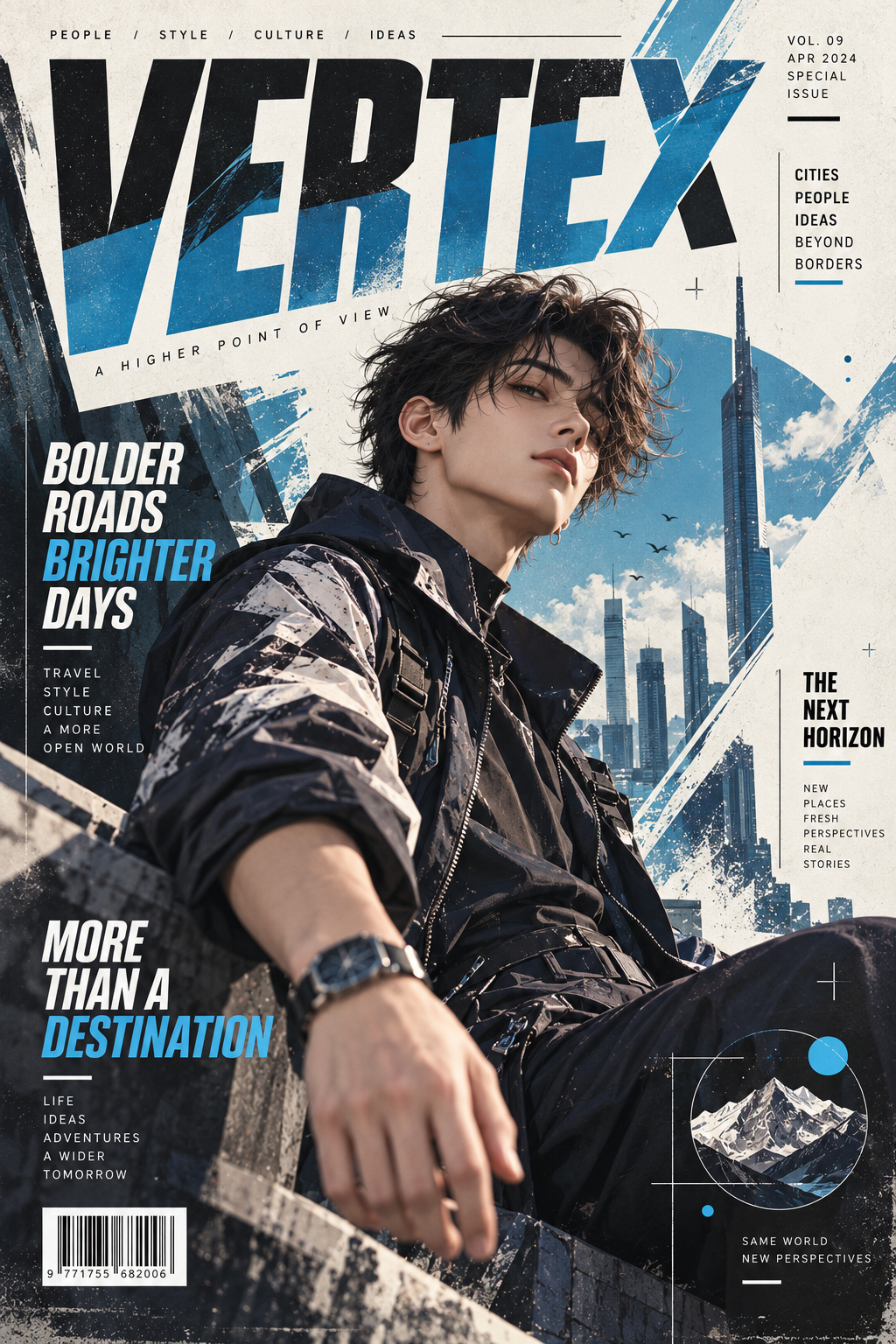
FRAME//SHIFT — Anime Editorial Magazine Cover
FRAME//SHIFT transforms original character concepts into striking illustrated editorial magazine covers. Combining premium anime artwork, contemporary streetwear, cinematic character portraits, expressive typography, distressed textures, and modern graphic design, this template creates visually distinctive publication covers. Customize the character's appearance, outfit, personality, environment, editorial headlines, color palette, and composition to generate original covers suitable for anime-inspired campaigns, character introductions, gaming publications, creative portfolios, and visual storytelling.
1. Template Details
Title: FRAME//SHIFT — Anime Editorial Magazine Cover
Slug: frame-shift-anime-editorial-magazine-cover
Short Description:
Create bold anime-inspired magazine covers featuring original male characters, expressive fashion styling, dramatic perspectives, oversized typography, and contemporary graphic compositions.
Full Description:
FRAME//SHIFT transforms original character concepts into striking illustrated editorial magazine covers. Combining premium anime artwork, contemporary streetwear, cinematic character portraits, expressive typography, distressed textures, and modern graphic design, this template creates visually distinctive publication covers. Customize the character's appearance, outfit, personality, environment, editorial headlines, color palette, and composition to generate original covers suitable for anime-inspired campaigns, character introductions, gaming publications, creative portfolios, and visual storytelling.
Category: Graphic Design & Illustration
Subcategory: Anime Editorial / Character Magazine
Template Type: Dynamic Prompt
Visual Style: Premium Anime Illustration, Contemporary Editorial Design, Graphic Streetwear Aesthetic
Dimensions: 1024 × 1536 px
Aspect Ratio: 2:3 Portrait
Tags:
anime magazine, anime editorial, character design, male anime character, illustrated magazine cover, anime poster, editorial illustration, streetwear character, graphic design, manga inspired art, cinematic anime, character portrait, oversized typography, distressed textures, anime fashion, visual storytelling, contemporary illustration, creative magazine, AI character art, anime graphic design, editorial typography, character showcase
2. Dynamic Image Generation Prompt
FRAME//SHIFT — Anime Editorial Magazine Cover
Create an exceptionally detailed, original anime-inspired editorial magazine cover featuring one distinctive adult male character.
The artwork should combine high-end anime character illustration, contemporary fashion editorial photography aesthetics, bold graphic design, experimental typography, and cinematic environmental storytelling.
The final result should look like a premium collectible art and culture magazine cover, with the visual energy of an illustrated character campaign.
The character must be entirely original. Do not reproduce an existing anime character, recognizable costume, signature hairstyle, or copyrighted character design.
Every generation should produce a different character identity, pose, outfit, environment, editorial narrative, composition, and color palette.
A. Dynamic Inputs
Magazine Identity
Magazine name: [MAGAZINE_NAME]
Magazine subtitle: [MAGAZINE_SUBTITLE]
Issue number: [ISSUE_NUMBER]
Publication date: [PUBLICATION_DATE]
Edition: [SPECIAL_EDITION]
Magazine category: [MAGAZINE_CATEGORY]
Publication tagline: [PUBLICATION_TAGLINE]
Character Identity
Character name: [CHARACTER_NAME]
Character title: [CHARACTER_TITLE]
Gender: Male
Adult age range: [AGE_RANGE]
Ethnicity or cultural background: [ETHNICITY]
Skin tone: [SKIN_TONE]
Face shape: [FACE_SHAPE]
Facial features: [FACIAL_FEATURES]
Eye color: [EYE_COLOR]
Hairstyle: [HAIRSTYLE]
Hair color: [HAIR_COLOR]
Body build: [BODY_BUILD]
Personality: [PERSONALITY]
Character background: [CHARACTER_BACKGROUND]
Fashion and Appearance
Fashion aesthetic: [FASHION_AESTHETIC]
Main outfit: [MAIN_OUTFIT]
Outerwear: [OUTERWEAR]
Footwear: [FOOTWEAR]
Accessories: [ACCESSORIES]
Materials: [MATERIALS]
Outfit colors: [OUTFIT_COLORS]
Signature design feature: [SIGNATURE_FEATURE]
Character Pose and Action
Pose: [POSE]
Hand positioning: [HAND_POSITIONING]
Camera angle: [CAMERA_ANGLE]
Perspective: [PERSPECTIVE]
Facial expression: [EXPRESSION]
Character gesture: [GESTURE]
Editorial Concept
Editorial theme: [EDITORIAL_THEME]
Main headline: [MAIN_HEADLINE]
Supporting headline: [SUPPORTING_HEADLINE]
Secondary coverlines: [SECONDARY_COVERLINES]
Featured story: [FEATURED_STORY]
Short description: [STORY_DESCRIPTION]
Featured quote: [FEATURED_QUOTE]
Environment
Location: [LOCATION]
Environment type: [ENVIRONMENT]
Background architecture: [ARCHITECTURE]
Environmental elements: [BACKGROUND_ELEMENTS]
Atmospheric effects: [ATMOSPHERE]
Graphic Art Direction
Primary color: [PRIMARY_COLOR]
Secondary color: [SECONDARY_COLOR]
Accent color: [ACCENT_COLOR]
Supporting colors: [SUPPORTING_COLORS]
Typography style: [TYPOGRAPHY_STYLE]
Graphic elements: [GRAPHIC_ELEMENTS]
Texture style: [TEXTURE_STYLE]
Layout direction: [LAYOUT_STYLE]
Text language: [TEXT_LANGUAGE]
Dimensions: [DIMENSIONS]
If any input is missing, invent an original choice that complements the remaining design. Never display raw variables, brackets, or placeholder instructions.
B. Main Character Illustration
Create one highly detailed adult male anime character as the dominant visual subject.
Preserve the specified face shape, facial features, hairstyle, hair color, skin tone, and body proportions.
The character should have a distinctive personality communicated through their facial expression, posture, clothing, and body language.
Use a premium anime illustration style with:
Detailed facial anatomy.
Expressive eyes.
Individual hair strands.
Carefully rendered fabric folds.
Detailed accessories.
Controlled highlights and shadows.
Refined linework.
Rich cel-shading combined with painterly rendering.
The character should look sophisticated, confident, and visually memorable.
Do not make the character resemble a recognizable existing anime protagonist.
C. Dynamic Character Pose
Use [POSE], [HAND_POSITIONING], [CAMERA_ANGLE], and [PERSPECTIVE] to create an expressive composition.
Explore unconventional poses rather than relying on standard standing portraits.
Possible approaches:
Seated with one arm extended toward the viewer.
Leaning against an architectural structure.
Looking over the shoulder.
Sitting on a rooftop ledge.
Standing with one hand adjusting the collar.
Reaching toward the camera.
Leaning forward with a relaxed posture.
Walking through a dramatic urban environment.
Use strong perspective and controlled foreshortening to give the character a powerful sense of depth.
Hands and facial anatomy must remain believable and well-rendered.
D. Fashion and Character Styling
Dress the character in [MAIN_OUTFIT], incorporating [OUTERWEAR], [FOOTWEAR], and [ACCESSORIES].
Use [MATERIALS] to establish the visual character of the outfit.
Possible fashion directions:
Contemporary Japanese streetwear.
Futuristic technical fashion.
Minimalist monochrome fashion.
Avant-garde oversized silhouettes.
Urban luxury fashion.
Cyberpunk-inspired clothing.
Contemporary traditional fusion.
Experimental high-fashion layering.
Apply [OUTFIT_COLORS] consistently.
Include [SIGNATURE_FEATURE] as a distinctive visual detail that makes the character recognizable.
Do not use recognizable branded clothing, logos, or copyrighted character costumes.
E. Editorial Environment
Build an atmospheric environment around [LOCATION], [ENVIRONMENT], and [ARCHITECTURE].
The background should support the character's personality and editorial theme.
Possible settings include:
Futuristic city rooftops.
Brutalist architectural structures.
Underground urban stations.
Rain-soaked city streets.
Minimalist concrete interiors.
Mountainous landscapes.
Abstract architectural spaces.
Night-time metropolitan environments.
Experimental art installations.
Integrate [BACKGROUND_ELEMENTS] and [ATMOSPHERE] without overcrowding the image.
Use environmental depth, silhouettes, atmospheric haze, and subtle lighting effects.
F. Magazine Masthead
Display [MAGAZINE_NAME] prominently across the upper portion of the cover.
Use bold, oversized editorial typography with a strong graphic identity.
Possible approaches:
Extra-bold condensed sans-serif.
Experimental stretched typography.
Heavy geometric lettering.
Distressed industrial typography.
Contemporary editorial display lettering.
Allow the masthead to interact with the character and background through carefully controlled overlaps.
Include [MAGAZINE_SUBTITLE], [ISSUE_NUMBER], and [PUBLICATION_DATE] in smaller supporting text.
The magazine identity must be original and correctly spelled.
G. Main Editorial Headline
Display [MAIN_HEADLINE] as the strongest supporting typographic element.
The headline should communicate the character's personality, story, or editorial theme.
Use expressive line breaks, strong typographic contrast, and selective color highlights.
Include [SUPPORTING_HEADLINE] and [SECONDARY_COVERLINES] in smaller positions.
The wording must be original and meaningful. Avoid generic phrases that could be reused on every character cover.
H. Graphic Design Elements
Create a distinctive graphic composition using [GRAPHIC_ELEMENTS].
Possible elements include:
Oversized abstract brushstrokes.
Angular color panels.
Distressed ink textures.
Circular technical diagrams.
Architectural line drawings.
Thin measurement lines.
Abstract symbols.
Halftone patterns.
Editorial markers.
Geometric framing elements.
Minimal technical annotations.
These elements should enhance the artwork and support the character's identity.
Avoid excessive decorative clutter or repetitive technical symbols.
I. Secondary Editorial Information
Include two or three compact editorial sections.
Each section should contain:
A short headline.
A meaningful supporting phrase.
A small visual accent.
Use [FEATURED_STORY], [STORY_DESCRIPTION], and [FEATURED_QUOTE] where appropriate.
Additional elements may include a barcode, issue details, publication category, or a small edition marker.
Keep every word in English unless another language is explicitly requested.
Do not generate Chinese, Japanese, Korean, or other foreign-language characters by default.
Do not include meaningless pseudo-writing, random symbols that resemble text, or decorative foreign-language typography.
J. Color Palette
Use [PRIMARY_COLOR], [SECONDARY_COLOR], [ACCENT_COLOR], and [SUPPORTING_COLORS].
The palette must influence:
Character clothing.
Background graphics.
Typography.
Environmental lighting.
Decorative elements.
Explore distinctive combinations such as:
Ice blue, graphite, and silver.
Emerald, cream, and charcoal.
Violet, lavender, and midnight black.
Burnt orange, slate, and ivory.
Burgundy, pale gray, and ink black.
Cobalt, white, and deep navy.
Acid green, muted gray, and black.
Do not automatically reuse the same color combination across generations.
K. Layout and Composition Variations
Choose a composition based on [LAYOUT_STYLE].
Avoid using a fixed template for every generation.
Possible compositions:
Oversized Typography: Giant masthead occupying the upper section, with the character extending across the center.
Asymmetrical Editorial: Character positioned off-center, with text blocks distributed along the opposite side.
Full-Bleed Character: Character fills most of the cover, with graphic typography integrated into the surrounding environment.
Diagonal Composition: Strong diagonal panels, slanted text, and a dynamic character pose.
Split Visual Narrative: Character dominates one section while a secondary illustrated environment or symbolic artwork occupies another.
Minimal Graphic Editorial: Large character illustration, restrained typography, and generous negative space.
The composition must remain visually balanced and preserve the character's visibility.
L. Illustration and Rendering Quality
Use premium anime illustration with contemporary editorial art direction.
Prioritize:
Consistent facial identity.
Detailed hair rendering.
Accurate hand anatomy.
Natural body proportions.
Detailed garment construction.
Controlled linework.
Rich shadow depth.
Cinematic color grading.
Professional graphic integration.
The result should feel like an original commissioned illustration for a premium anime and culture publication.
M. Final Output Requirements
Generate one high-resolution illustrated magazine cover in 1024 × 1536 px portrait format.
The final artwork must contain:
One original adult male anime character.
Distinctive character styling.
An expressive and unconventional pose.
A meaningful environment.
An original magazine masthead.
A strong primary headline.
Supporting editorial coverlines.
Bold graphic design elements.
A coordinated color palette.
Sophisticated editorial typography.
Negative constraints: No copyrighted anime characters, no recognizable existing costumes, no copied magazine mastheads, no Chinese or Japanese text, no foreign-language text unless requested, no meaningless lettering, no duplicated headlines, no distorted hands, no malformed anatomy, no watermarks, and no unwanted padding.