


 Image
Character sheet
Darkborn — The Fallen Oracle Character Sheet
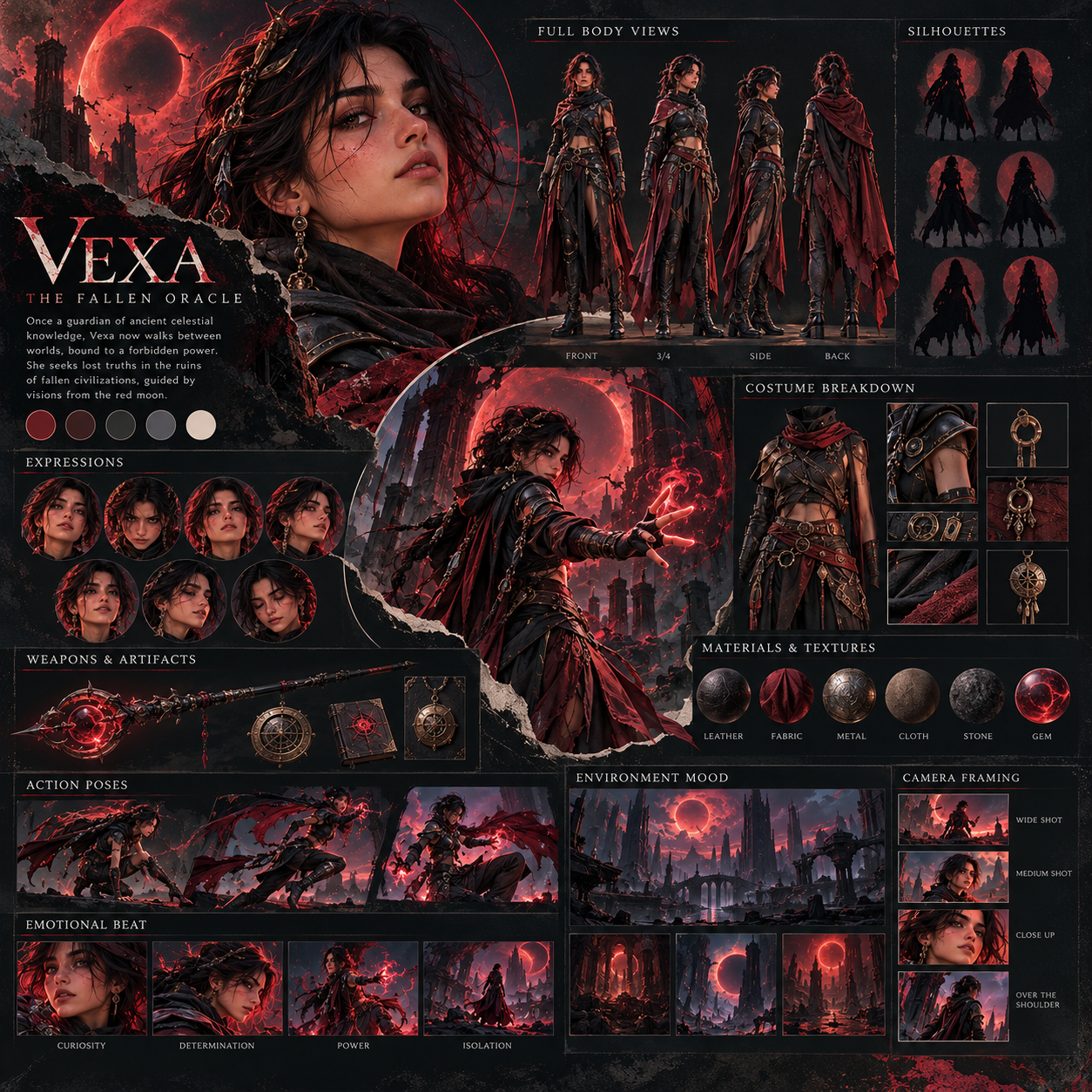
Darkborn is a cinematic dark-fantasy character-sheet template designed for original villains, anti-heroes, supernatural beings, and mysterious fantasy protagonists. Featuring Vexa, the Fallen Oracle, this concept combines a dramatic hero portrait, full-body turnaround views, silhouette exploration, facial expressions, costume breakdowns, weapon and artifact studies, material samples, action poses, environment concepts, and emotional story beats. A charcoal-black foundation, blood-red supernatural lighting, antique bronze details, and distressed textures create a cohesive visual dossier for AI filmmaking, animation, game development, and character-driven storytelling.
Create a highly detailed, cinematic dark-fantasy character design dossier for an original female anti-hero named Vexa, The Fallen Oracle. The image should resemble a premium production concept-art board created for a fantasy film, AAA video game, or animated series.
The board must establish a consistent character identity while presenting her visual design, costume construction, supernatural abilities, signature artifacts, action poses, environment, and emotional progression.
1. Character Identity
Vexa is a mysterious former guardian of celestial knowledge who became bound to forbidden magic after discovering the ruins of an ancient civilization.
She is a young adult woman with pale olive skin, sharp cheekbones, dark expressive eyes, long untamed black hair with subtle crimson highlights, and a composed but intimidating presence. Her face should communicate intelligence, grief, determination, and restrained supernatural power.
Her design should feel original, sophisticated, and memorable—not a generic fantasy sorceress.
Maintain the same face, hairstyle, body proportions, costume design, and distinctive accessories across every panel.
2. Signature Costume
Dress Vexa in layered black leather armor, an asymmetrical dark-crimson cloak, weathered charcoal fabric, antique bronze fasteners, engraved shoulder guards, fitted gauntlets, utility belts, and tall armored boots.
Include subtle celestial engravings, fractured circular motifs, and small red gemstone details that suggest her connection to forbidden cosmic knowledge.
Her costume should be functional and believable, with visible stitching, worn leather, metallic scratches, fabric fraying, and carefully designed armor construction.
Avoid excessive armor spikes, generic fantasy crowns, exaggerated shoulder pieces, or unnecessarily revealing clothing.
3. Distinctive Character-Sheet Layout
Create an asymmetrical square composition with irregular panel sizes, overlapping visual elements, distressed borders, and a dark dossier-like aesthetic. Avoid a simple, uniform grid.
Hero portrait — upper-left: A large cinematic close-up of Vexa against a shadowy gothic ruin, with crimson rim lighting outlining her hair and armor. Her expression is controlled, serious, and enigmatic.
Character turnaround — upper-right: Four full-body views showing front, three-quarter, side, and rear perspectives. Keep her proportions, cloak, armor, belts, and accessories consistent.
Silhouette studies — far-right: Several dark silhouettes exploring variations in cloak shape, stance, weapon placement, and overall outline.
Expression studies — middle-left: Six close-up portraits showing neutral composure, suspicion, anger, grief, determination, and controlled supernatural intensity. Preserve the same facial identity throughout.
Central action illustration: A large dynamic scene showing Vexa extending one hand as crimson magical energy fractures the air around an ancient celestial artifact. Her cloak and hair react naturally to the magical force.
Costume breakdown — middle-right: Detailed close-ups of her shoulder armor, engraved gauntlets, cloak fasteners, leather straps, and bronze ornaments.
Weapons and artifacts — lower-left: Design a long dark-metal staff with a suspended crimson crystal, an ancient circular astrolabe, a weathered prophecy book, and a small celestial relic. These objects should share a coherent visual design language.
Materials and textures — lower-right: Display carefully rendered samples of distressed black leather, dark-red woven fabric, weathered bronze, volcanic stone, blackened steel, and translucent crimson crystal.
Action poses — bottom section: Show Vexa casting a spell, moving through ruined architecture, defending herself with her staff, and standing against a supernatural storm.
Environment mood — bottom-center: Include small cinematic views of ruined gothic towers, a broken celestial observatory, a black-stone bridge, and a blood-red eclipse over a ruined kingdom.
Camera framing — bottom-right: Show a wide establishing shot, a medium character shot, a close-up portrait, and an over-the-shoulder composition.
Emotional progression: Include small cinematic images representing isolation, discovery, grief, determination, and the acceptance of forbidden power.
4. Color Palette
Use a tightly controlled dark-fantasy palette:
Obsidian black and charcoal for the background.
Blood crimson and deep burgundy for supernatural energy.
Antique bronze for armor details and artifacts.
Smoky gray for stone and atmospheric depth.
Muted ivory for restrained text and panel labels.
Use crimson as a selective accent rather than flooding the entire board with red. Preserve dark shadows while keeping important costume details and facial features readable.
5. Lighting and Atmosphere
Use dramatic low-key cinematic lighting, crimson edge illumination, faint volumetric mist, subtle floating ash, atmospheric depth, and reflective highlights on metal and crystal.
The hero portrait should have strong facial definition and realistic skin texture. The environment should feel ancient, ominous, and vast without overpowering the character.
Maintain a consistent lighting language across the board, with small variations in the action scenes to communicate changes in magical intensity.
6. Typography and Information Design
Use a refined, high-contrast serif title paired with compact uppercase sans-serif section labels.
The main heading should read:
VEXA
Subtitle:
THE FALLEN ORACLE
Add a short lore description explaining her former role as a guardian of celestial knowledge and her connection to forbidden power.
Use concise section labels such as:
CHARACTER TURNAROUND
SILHOUETTE STUDIES
FACIAL EXPRESSIONS
COSTUME BREAKDOWN
WEAPONS & ARTIFACTS
MATERIALS & TEXTURES
ACTION POSES
ENVIRONMENT MOOD
CAMERA FRAMING
EMOTIONAL PROGRESSION
Typography must be legible, restrained, and secondary to the artwork. Avoid excessive decorative lettering or random pseudo-text.
7. Rendering Quality
Use premium cinematic concept art with realistic material rendering, detailed costume construction, expressive facial animation references, sophisticated composition, and painterly environmental detail.
The sheet should feel like a unified professional production document rather than a collection of unrelated images.
Prioritize character consistency and design readability over decorative complexity.
8. Final Output
Aspect ratio: EXACTLY 1:1 square, 1024 × 1024.
Create a complete, polished character-design sheet that can be used as a visual reference for subsequent AI-generated scenes, animation sequences, game cinematics, and fantasy storytelling.
Negative constraints: No inconsistent character faces, no costume changes between turnaround views, no extra limbs, no distorted hands, no duplicate weapons, no random characters, no excessive gore, no explicit content, no watermarks, no modern objects, no illegible typography, no portrait-format output, and no white padding outside the square canvas.